light vessel automatic

skip to navigation

what makes you think there’s something on my mind?

May 29, 2004

goat face

When I came to Japan, my sister asked me to get her a t-shirt with some crazy, Japanese English slogans on it. The problem, though, is that there’s a big difference between what’s funny when you see it on someone’s shirt in the street, and what is actually funny enough to be worth getting for someone, and so I haven’t been able to find a t-shirt quite good enough. Until now! Last time I went to the mainland, I finally found the t-shirt I’ve been looking for. It says, in big bold silver letters:

WHAT MAKES YOU THINK THERE’S SOMETHING ON MY MIND?

And then, to clarify things, in small, black cursive writing, partly overlaying the main question:

I remember before I was born, wounded up like a fur ball in the highly overrated fetal position, luckily I’m not claustrophobic, but on rainy days I still feel a tightness in my left shoulder. So now that my stepmother’s pregnant, I understand what the baby’s going through, and I’m not jealous at all, really, not at all.

Which should also lay to rest the idea that these t-shirts are made by people who don’t speak English. Whoever wrote that knew exactly what they were saying.

Of all the Japanese-English t-shirts I’ve seen, my favourite said ‘I have fallen, and I can’t get up.‘ The best one I’ve ever heard of was seen by another JET teacher on a boy of about twelve, walking with his family in a garden in Kyoto. It said ‘Ten Inch Shit.

Simple, beautiful, profound.

Image: either Japanese tv, or a photo I took in a dream. I don’t remember any more.

posted in Okinawano comments

1984

May 24, 2004

I wrote this a while ago, and have been putting off putting it here because it’s not about Japan, and it says nothing especially new. And besides, what right do I have to talk politics at you, when you’ve come here to look at pictures of Okinawa? None in particular, I know. But I’m going to, just because I have a voice, and feel an obligation to use it. Not because anything I can say can be of much consequence, but just because I can – because that’s all I can think of to do. To add another voice to the angry electronic chatter.

I haven’t been updating much recently. There are a number of reasons for this – partly, I’ve been busy; partly, I haven’t taken many photos recently; partly, I’ve been redesigning the whole site to make it prettier, nicer, cleverer (soon, soon…). Part of the reason, though, has been that every time I have access to an internet connection, I’ve been more inclined to read the news than to write about fun, trivial things I’ve been doing on my small, safe island. Every time I read the paper, the blue skies and tree-covered hills I can see from my desk seem to fade out, and I feel the horrible fascination of seeing something terrible unfold before one’s eyes.

Living on small island, I’ve had time to catch up on a lot of reading – to read big, fat books that were too daunting when I lived in a city, to read classics that were never quite as appealing as whatever detective novel happened to be to hand – and one book I finally got around to reading earlier this year was 1984. And although it’s more-or-less become a cliché to describe that book as ‘perenially relevant’… today when I read the news, I read about torture in the name of human rights, indefinite imprisonment without charge in the name of freedom, occurring against the backdrop of a war in the name of peace, and I can’t help but think there’s some serious doublethink going on.

One interesting thing, reading 1984, was realising that book’s name has become so synonymous with certain of its warnings – state surveillance of the individual, political control of language – that others often tend to be forgotten. One theme in 1984 concerns the political usefulness of endless war in rallying the public behind a corrupt regime. I wonder, though, whether any previous episode of history could have been a better model for ‘endless war’ than the current War on Terror – not a war against any particular country or organisation, not even a war against a particular doctrine. A war that can be allowed to go on as long as it’s useful, and struck up again whenever there’s trouble at home. What could end the war on terror? The end of al-Qaeda? I’m still not clear what the final, settled-on reason for the war in Iraq was (other than “he was a bad, bad man”), but even Bush and Blair long ago gave up trying to draw any connection there.

1984’s direst warning is that, given the right conditions, a regime could exist that, once in place, would be impossible to bring down. I am not suggesting that any regime today has quite that ambition, but I do think that a lot of the ways in which the world is being changed could pave the way for worse to come. In both the US and the UK – and many other parts of the world – politicians are scrabbling more frantically than ever to please and appease politically unaccountable, usually commercial, interests, and in the process very important freedoms and rights are being trampled on: the right to a fair trial, for example. Freedom of speech. The unacceptability of torture of anyone, whether they be a ‘prisoner of war’ or an ‘unlawful combatant’ (the difference words make: the former are covered by the Geneva convention, and thus torturing them is a no-no. But here the ‘war on terror’ comes in handy again: since it’s not a war on any concretely-definable enemy, that provides a fair bit of room to play around with what you call your prisoners. Finding international law a little inconvenient? Just redefine your terms! Another game that Orwell understood).

I feel vaguely ill at writing all this, shaking my fist from a tiny island at something so massive and far away, and the only people hearing me are… a bunch of my friends, who probably agree with me, have probably heard and thought it all before, and almost certainly came here to see some photos of Japan. Who do I think I am? The best excuse I can offer for getting all political is simply that I feel speaking out isn’t a right but an obligation – the more people who stand up and scream and shake their tiny fists at the outrages committed by their governments, the more chance there is that things might change.

posted in Okinawa4 comments

taiko

May 17, 2004

taiko
taiko

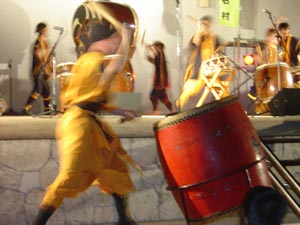
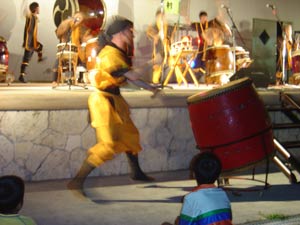
Well, I’m now finally a full member of the island’s taiko-drumming group, and my first performance was on Saturday, which completes an arc of weirdness that began two years ago in London, when, completely by chance, I saw them performing on the South Bank along with my two predecessors – the only other two westerners to have lived on this island, in all likelihood (I’ve told that story previously here). It’s complete madness: in a London street, I watch and enjoy a band from a small island on the other side of the world, and then I walk off without even finding out their name. Two years later, by pure coincidence, I am living on that small island, and my next door neighbours run the band. A few months after that, and I’m a member.

I began practising weekly with the group in January, but for the three weeks or so leading up to the concert, we were practicing for an hour or two every evening. My hands are getting quite nicely calloused, and I think I might even be getting fit. Taiko involves a lot of movement, and this particular group jump around even more than most (which was why when I subsequently saw other taiko groups in the UK, I always compared them back to the first one I saw, and felt that there was just something lacking…)

Most of the band members are around my age, and most of them have been doing taiko since they were kids, which means they now absolutely rock. It’s pretty daunting (but very fun) being in a band with people so outrageously good, but it’s a good incentive to get good myself. We’ve got more concerts coming up in July and August, and I’m determined not to make any mistakes next time round…

posted in Okinawano comments

bureaucracy

May 14, 2004

Before you read this, please take a deep breath. Maybe make yourself a cup of coffee or something. I have written far more here than I have any right to expect anyone to read…

When I first arrived here, I was shocked at the bureaucracy. Of course, a new arrival in a foreign country probably gets a particularly big exposure to that country’s bureacracy, but what really shocked me was the realisation that a country that in my mind was the most futuristic, technologically advanced place on the planet in fact relies for the most part on paper stamped in triplicate and the postal system in situations where almost all developed countries (and frankly, probably a fair number of developing countries, too) would have a computer system in place, and that it seems to flag behind Britain (and probably most of Europe) in pretty much all non-gadgety implementations of technology. If you want phones with built-in 1.3 megapixel video cameras and megabytes of memory, Japan is the place to come. Just don’t expect cash machines that are open outside office hours, is all (they’re mostly manned, apparently…) Liquid crystal tvs in cars? Yes, but don’t expect to buy one with a credit card: Japan is cash only, in all but large hotels and department stores. The prevalence of the office, and of the shuffling and stamping of forms, came as a surprise and a puzzle to me. Recently, though, I discovered something about Japan’s bureaucracy – something which has led me to see a lot of the things around me in a new light.

At the beginning of April, there was a big staff change in the board of education. I didn’t think much about it at the time – lots of teachers change schools at that time, too, because it’s the beginning of the academic year (like I said before, none of the teachers stay on my island for longer than three years). But over the last couple of weeks, I began to notice that other places seemed to have had a change of staff, too. I didn’t put two and two together until T-sensei, the maths teacher, said yesterday that school dinners have got better this year, now that S-san is running the school dinner center. And then it clicked: everyone has changed jobs. Almost without exception, everyone on the island with a public-service job – the village office, the board of education, the school dinner center, and so on – has swapped jobs with someone else, in a different office. Dozens of people, changing jobs after one year.

At the time, that just seemed surprising, but I thought “fair enough – I suppose it’s a way of limiting the damage that anyone who’s really bad at their job can do, by shuffling them somewhere else after a year.” I could see how that could work. But I kept coming back to it, puzzling about it, and I realised that it also means a number of other things. It puts very tight limits on the extent to which anyone can learn from their mistakes, or get useful experience at anything other than shuffling paper. It also means that for the most part roles that could be filled by someone with some level of experience in the field in question (education, say, or environmental management) are presumably filled by people who can really only bring to it general-purpose experience of office work. Suddenly, the huge amount of paperwork and bureaucracy that I’ve been seeing everywhere began to make sense, and I began to think again about some of the things that have struck me or bothered me since coming here.

My island is a place in decline. The population is less than half what it was thirty years or so ago, and if you spend an afternoon walking around, you see the signs all over the place: coastal footpaths and paths through the hills that are now overgrown and impassable in places; picnic areas whose toilets are out of order and which are clearly rarely tended, let alone used. At first, this all just seemed sad – a sign of the changing times, an unfortunate consequence of Japan’s (or for that matter, any country’s) technological and commercial development presumably having been that people leave relatively poor rural areas for the big city, and don’t come back.

But recently, I began to wonder to what extent it is a sign of this. I began to notice that all over the place there are signs of staggering mismanagement. Picnic areas stand virtually unused on the hills, but meanwhile they appear to be constructing new ones along the coast. With car parks. On the north coast of the island, there is a viewing tower shaped like a monstrous voodoo face. It’s about five-stories tall, and it’s made of sculpted concrete that looks like fibreglass. The effect is like something that’s been lifted out of a third-rate would-be Disneyland, and the main appeal of climbing to the top is that that is the one place in the vicinity where your view of the next island isn’t obstructed by a grotesque voodoo tower. Around the tower’s base are an adventure playground – again, overgrown with creepers, although it’s probably only a few years old – and a car park, in which I have never seen a single car parked.

The whole thing makes me think of the cargo cults that arose on some islands in the South Seas. The islanders, realising that the source of all the Europeans’ cargo (and therefore wealth and power) were aeroplanes, set about constructing full-size runways in the forest, so that the planes could deliver their cargo to them, too. This island also seems to have been developed with an ‘if you build it, they will come’ philosophy in mind: What do tourist attractions have? Picnic areas, car parks, giant concrete faces. Therefore, if you build these things, you will have a tourist attraction. And so a beautiful, semi-tropical island is concreted over at a cost the local council can’t afford (the village office is widely rumoured to be in very serious debt), in an effort to make it a tourist attraction.

The coral reef that surrounds the island is dying, too. At first, I assumed that this was due to climate change, since coral reefs are now calcifying and dying at a fairly rapid rate all over the world. But a couple of months ago, I learnt that the neighbouring island, which is larger but less populated, has an intact reef, less than two kilometres away. No-one knows why the reef on this island is dying, but I’ve heard a number of people blame it on the huge amount of construction work (and consequently deforestation and stirring up of sediment) on and around the island.

But if the people in charge of development here are only in their job for one year before being shuffled to some other department, if the only useful experience they bring to the job is whatever office skills they have, is it any wonder that things are as they are? The philosophy behind this annual job-shuffling would seem to be that managing children’s education, managing commercial and agricultural development, and managing the environment are all essentially just managing something. Unfortunately, the extent to which educational management is anything like environmental management seems to be indicated by the dying coral reef, the acres of empty car-parks, and a monstrous concrete face.

Of course, I live on a small island in a rather atypical corner of Japan, and so I can’t really generalise to the whole of Japan. Next, I have to find out how widespread the practice of everyone swapping jobs is. If it’s peculiar to my island it wouldn’t go far as an explanation of Japan’s bureacracy, but I know that a certain amount of job-swapping happened in the (local government) office where Kim works at the same time… I strongly suspect this is a Japan-wide thing.

It’s a sad fact that one of my reasons for wanting to scuba-dive is to experience a beautiful thing while it still has some glory left in it. The things I’ve seen lately have made me begin to fear that learning Japanese might turn out to be a similar exercise. I hope it doesn’t, because I want to hold on to my belief that the world has things to learn from Japan, but the more I see of Japan, the more pessimistic I become about it.

posted in Okinawano comments

light-bulb nutrients

April 24, 2004

There are are a number of myths about foreigners that a surprising number of people in Japan seem to believe to a greater or lesser extent. A lot of these are to do with how difficult it must be to live in Japan if you’re not Japanese. One problem is that the Japanese language is almost impossible for foreigners to ever grasp. We might learn enough to read roadsigns and menus, ask for directions, have conversations, and maybe even read Japanese literature, but we can never really grasp the language, because it’s so difficult. Another difficulty foreigners face is the challenge of having to eat with chopsticks instead of spoons, and consequently we face the real threat of malnourishment in the midst of plenty, just because everything we try to eat just slips off our chopsticks before it reaches our mouths.

This is a particularly odd myth, because it seems to be based on an idea that chopsticks are specifically Japanese, and misses the fact that just across the East China Sea, on mainland Asia, about a fifth of the world’s population – and all of them foreigners – are also getting by perfectly ok with chopsticks. The insular mindset that the whole “ooh, you’re eating with chopsticks” attitude implies annoys me, and I usually can’t help saying something along the lines of “yeah, well, there are loads of Chinese restaurants in Britain, see…”

Another difficulty for foreigners is that there are so few of us – Japan is one of the most culturally homogenous countries in the world – so we must be lonely. Although inquiries about loneliness are always well-meant, they still boil down to a benevolent sort of racism, because the implicit assumption seems to be that we couldn’t have Japanese friends.

The last two myths (plus God knows how many others that I’m not aware of, and which, together, might actually make some sense of what follows) came together in a surreal exchange in the supermarket queue the other day with the school librarian, who seems to particuarly enthusiastically buy into mad ideas about foreigners. She pointed at my shopping basket – which contained only a carton of fruit juice and a 60 Watt light bulb – and then at her full basket and looked at me and giggled, as if I should understand what the joke was. This set my teeth on edge, so I asked what was funny. She explained that “I have to buy all this because I have so many mouths to feed. But you live alone, so you don’t need much at all.”

As with lots of the things she says, my mind reeled trying to grasp the network of assumptions that you would have to hold in order to think that that made any kind of sense… She has a family, so she has to buy lots of food, whereas I, being alone and foreign, can subsist off nothing more than a carton of fruit juice and whatever nutrients I can lick off the glassy surface of a light-bulb? If so, how long does she think one light-bulb lasts me? That’s what I want to know.

posted in Okinawano comments

another year

April 9, 2004

waterlily

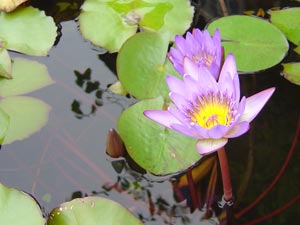
Well. A few weeks ago I decided to stay out here for another year, mainly because while one year has been enough to improve my Japanese and learn the very basics of scuba-diving, taiko-drumming, and sanshin playing, I’m not sure that any of it has stuck well enough that it wouldn’t slip away after a few months back in Britain. I think another year should be enough to actually put these things into practice, though, and make sure I’ve got something permanent out of being here. I’m going to assume, though, that after this year I’ll be going back to Britain. Not because I necessarily will, but because if I decide to stay a third year I don’t want it to be because I feel I didn’t do enough in my second. Besides, I’m already daydreaming about Norway, Hungary, Namibia and (as of this afternoon) Ghana…

Wednesday of this week was the start of a new term, and a new school year (they run from April to March in Japan), and in true Japanese style we started the term with not one but three opening ceremonies, back-to-back. A big difference between Britain and Japan is that here, people’s ceremony-tolerating threshold is extremely high. As the vice-principal announced the closure of the first ceremony – to welcome the new teachers – I thought “Wow. That was surprisingly bearable – only fifty minutes.” But then, without a pause, the Principal got up and announced the opening of the ‘starting the term ceremony’. Another forty-five minutes or so. Then a five-minute toilet break, before the ‘welcoming the new students’ ceremony started. This overlapped considerably in content with the initial ‘welcoming the new teachers’ ceremony, and it seemed to me that with a little forethought these two ceremonies could have been condensed into the one, general ‘welcome’ ceremony, which would probably have freed up at least half an hour of precious life, and necessitated singing the horrible, horrible school anthem only once. There is a bit in the anthem where the piano plays a jaunty descending major bassline that has surely been lifted from a novelty song of the 1950s, or a really bad country and western number. Horrible.

posted in Okinawano comments

temples and gardens

April 8, 2004

hooded buddhas

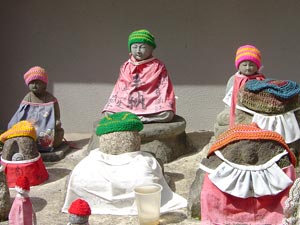
I’m back on the island after a week or so’s absence going round Kyoto and Okinawa with my parents. On my previous, brief visit to Kyoto at New Year, I only saw a couple of temples, but this time the cherry-trees exploded into blossom on about the day after we arrived, and we went temple-beserk. If you find yourself in Kyoto, my top two temples are Kinkakuji (金閣寺), the Golden Pavilion, which – true to its name – is almost entirely covered in gold, and Kiyomizu Temple (清水寺), which is a collection of several buildings, all very different, and each of which individually would kick the arse of most other temples in the vicinity.

Quite a few of the temples had Zen rock gardens, and I was surprised to find that while some immediately struck me as balanced and peaceful and quite possibly the product of someone who knows something rather profound, others, though superficially similar, seemed as if someone had just raked some gravel into pretty shapes. I began to wonder if my instant discrimination between ‘fake’ and ‘real’ Zen gardens was a sign that I understood something – perhaps even of imminent enlightenment – but my optimism was shattered when, on reaching the last garden of the day (one of the ‘real’ ones) whose only prominent features were two large and slightly rounded mounds that seemed to be emerging from an otherwise calm sea of gravel, one of the first thoughts to ripple the tranquil, pondlike surface of my mind concerned their hilarious (and not entirely vague) resemblance to… the breasts on a lady! Imagine that! A great big nude lady, hiding under the gravel, just biding her time, waiting to jump out and startle a passing monk!

posted in Japanno comments

two pictures from my telephone’s mind

March 26, 2004

a sparkler
stars

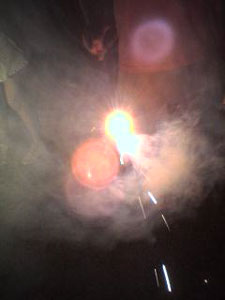
Lately the weather here has been pretty grey, and I’ve been too busy with end of term stuff to take any photos. The other night, though, I was rummaging through the contents of my mobile phone’s tiny electronic mind, and I found I’ve got a few quite nice pictures that I’ve taken with it. So here, for starters, are a couple of the artiest.

The top picture is of a sparkler, held by a small child.

The bottom picture… I don’t know what it’s a picture of, actually. I’ve forgotten. I know I took it quite recently – I remember taking it. I just don’t remember what I was looking at or why. Let’s say it’s the night sky. The beautiful night sky. And it’s one of those really long exposures so you can actually see the movement of the stars along their ancient paths. It’s not, of course. It’s probably oncoming traffic or something. But that’s not so evocative, is it?

Right. So. Tomorrow I’m off to Osaka again – this time to meet my mum and dad who are coming over for the spring break. So I’ll be out of range for a little while. Please don’t take this as an invitation to burgle my house, but please do take it as an excuse if I owe you an email and you’re wondering where I’ve got to – things have been hectic lately, is all…

posted in Okinawano comments

the great jenga tower

March 22, 2004

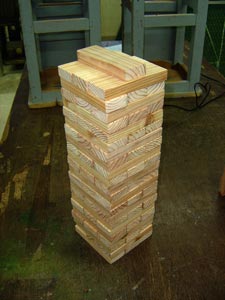
tower of jenga

Today I helped T sensei, the maths teacher, construct a Jenga set. The tower in the photo is not yet complete – when finished it will be half as high again, towering a foot and a half above whatever table-top it is placed on, and visible from many meters away. My arms ache from all the sanding, but construction must be completed by tomorrow evening, because the opening ceremony will be at the goodbye meal for five of the junior high school teachers.

Wednesday is the last day of term (Japan’s school year goes from April to April), and teachers here are always on short contracts, changing schools every few years. On the small islands the contracts are even shorter – no teacher stays longer than three years. This means that every year, about a third of the teachers in the school change. This is a fact that has sometimes creeped me out in the past: none of the teachers (or students, since there are only three years) have been here more than three years, but the school itself has stood here for forty years or so. So what is the school? In the right frame of mind, the transience of the people and continuity of the school can make you feel like the school is some kind of weird, looming presence. A huge cowlike thing, on whose back we are merely flies. Which makes no sense when I take a step back from my thoughts, but why should I do that?

Ooh. I just realised that thinking of the school as a ‘presence’ comes from the mistaken assumption that the meaningfulness of a word necessitates the existence of a corresponding thing! Doh! Fancy making that old mistake…! Anyway, I’m not creeped out by the school’s existence any more. Thank goodness I spent four years of my life studying philosophy… to think that at the time it all seemed like a lot of old nonsense and a waste of time which would have been better spent reading detective novels and learning the harmonica…

Also: I am now a licensed scuba-diver. Splendid! Don’t be too impressed, though – to get the basic license you need to be just about capable of avoiding death and/or bursting your eardrums. Which I think I am. Anyway, I’m looking forward to finding out.

posted in Okinawano comments

a musical interlude

March 12, 2004

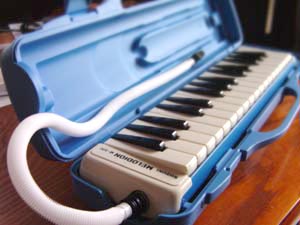
Suzuki Melodion

On Friday evening, after the conference was over, I played my first proper public gig since coming to Japan. Actually, it was my second, but the first – a few months ago – was to a roomful of businessmen who were having a business-card swapping party on my island, which was a weird experience, and came about only because I was playing in my neighbour’s cafe a few days before and he – possibly slightly happy on booze – invited me to come and play at the card-swapping party, for which he was organising the entertainments.

Anyway, the occasion was a ball for the foreign English teachers of Okinawa. A few weeks ago I was staying with Leigh (see the previous entry) and his wife Anna in the big city, and she was trying to organise this ball. I’d been thinking about the possibility of putting on some sort of open-stage event, so I suggested that as the entertainment for the ball. Someone else organised the whole thing, though, so all I had to do was agree to come and be one of the performers. I just assumed that virtually everyone else who played would also be turning up with acoustic guitars, but I was pleasantly wrong. There were six performances, and they were about as varied as six performances could have been: a piece by Chopin, played on the grand piano, a Chinese pop song, accompanied by piano, a karate demonstration, a Hawaiian dance, and a Hawaiian song performed on the ukelele and accompanied by another Hawaiian dance (a surprising number of the other JET teachers in Okinawa are from Hawaii, because there was a lot of emigration from Okinawa to Hawaii following the second World War, and so now lots of young Hawaiians have relatives in Okinawa that they want to re-establish relations with). And me with an acoustic guitar.

As well as giving me a taste for performing again (darling), playing a couple of my songs made me realise how useful playing an instrument is when you live on a remote island, and so don’t know many people in the big city. If you turn up somewhere, and play a bit of music, it gives everybody in the room an excuse to come up and chat to you. Consequently, I finished the evening feeling I knew about seven times more people on mainland Okinawa than I had the day before.

Rather than rush back to the island, I spent Saturday wandering round the city, taking the opportunity to do things like sit in cafés, and buy a melodion (pictured, also known as a melodica), which is a kids’ keyboard instrument that sounds like an accordion, which you play by blowing into via a length of flexible tubing. Nice. I’ve wanted one for ages. In the evening, I headed up the mainland to a small town where a bloke I met the previous day was having a birthday party. It was in a little bar with bongos and djembes and various instruments lying around, and it turned into a big musical session, with everyone taking it in turns to hit things. I played guitar for a bit, and then I got out my melodion and played along on that for a while, too. Good god! It might be meant for children, but it’s loud enough to compete with an electric guitar!

Anyway, the bloke who owns the bar seemed very nice, spoke good English (having lived in London for two years), was clearly into live music, and was one of the best harmonica players I’ve ever met. So now I’m hoping that I might be able to get some sort of occasional open-stage night going there. I’m going back next month, so we’ll see what happens then…

I also found a nice bar in the city that has Guiness on tap. Slightly wrong-tasting Guiness, admittedly, but still probably the closest thing I’m going to get in this region of the planet.

Here‘s an interesting article in today’s Guardian by a man travelling round Kyoto, where I’m going in two weeks’ time. It’s particularly interesting because he’s the first person I’ve ever come across who enjoys the notorious Japanese denki furo (電気風呂), or electric bath.

posted in Okinawano comments