light vessel automatic

skip to navigation

through the tiny door

March 9, 2004
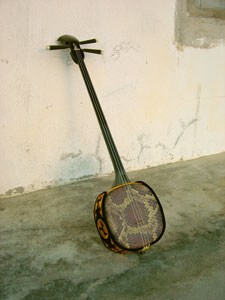
a sanshin

Well, I don’t know about you, but I just had a really good weekend.

In fact the portion of time I am considering ‘weekend’ starts last Thursday, because I went to a language and culture conference in the big city, which meant two days of learning Japanese and sanshin (Okinawan banjo) instead of being at school. Nice.

On Wednesday, though, it looked like I wouldn’t be able to leave the island. The boat stopped running on Tuesday afternoon, due to high winds and five meter waves, and when I called the island’s airport, both Wednesday and Thursday’s planes were full. Luckily, someone cancelled on Wednesday night, and the bloke from the airport called me back to let me know. (There’s a great thing about living on a small island – people know who and where you are. That can be a disadvantage, too, but when it comes to ‘I need to get off the island’ emergencies, it’s pretty handy. The bloke who runs the airport, by the way, also runs the island’s rent-a-car business. The airport is so small that running it single-handedly isn’t a full-time job).

So, half-noon on Thursday saw me climbing into the Okinawan skies on board a twin-engined eight-seater propellor plane which I shared with seven men in the pale blue overalls that all manual workers in Japan seem to wear, en route for the big city. Thursday afternoon was spent learning to read sanshin score – much easier than reading Western notation, since I’ve tried and failed to learn that several times but was beginning to get the hang of reading for the sanshin by half-past-four. (It helps that there are only twelve notes, and you only play one at a time).

In the evening, rather than be sociable and go out with all the teachers, I just went out to get something to eat and drink with Leigh, a friend who lives in the big city. After a few drinks in a German beer place, Leigh offered to give me a walking tour of the dingy area where all the interesting bars are. Leigh is a semi-professional photographer, and so has an eye for strange, tucked-out-of-the-way places, and as we walked, he described to me the building he wanted to show me – a place that had been a pachinko (Japanese pinball) parlour in the 1950s, and was covered in so many neon tubes that, though it’s tucked down a side street in Naha, Okinawa, must once have rivalled with its equivalents in Shinjuku, central Tokyo. And he’s right – it must have done, but now it’s a dirty concrete building covered in cracked, dead neon tubes and peeling fly-posters, and surrounded by tiny, unwelcoming bars. I was looking up and down the front of it, at the huge faded letters painted on the concrete frontage, and the posters covering the now shuttered-up ground floor, when Leigh said, “Well – what do you think? Do you want to go in?” “Go in? – what? In here?” I asked. “Yeah,” said Leigh, “that’s the door.” He was pointing to the grubby shutters right in front of me. And there – though I hadn’t even noticed it – was a tiny door, less than five feet high, and half-hidden by gummed-on, cheaply-photocopied adverts for club nights.

So we pushed open the tiny door, and ducked through it, into a small, dark space in which I could see nothing, but could hear voices and soft reggae music playing somewhere nearby. Up a very small flight of stairs, and we found ourselves in a dark, warmly-lit bar, with lots of windy metal shapes and a few hip Japanese people in beany hats. We ducked through a four-foot hole that seemed to have been punched through a wall, and sat down in an unlikely-shaped, low-ceilinged alcove, lit by a single yellow light bulb. A strange but beautiful secret pub, hidden in an apparently abandoned amusement arcade – the kind of place I visit in my dreams.

After we left the pub, we wandered through a maze of twisty little alleyways, peering through half-closed doors into bars about the size of a not-particularly-large bathroom. Bars in Japan seem to work on very different commercial principles to those in the UK: whereas UK bars and pubs for the most part try to be visible, and to draw in new customers with things like special offers and looking welcoming, bars in Japan often seem to follow almost the reverse principles – they are tiny, exclusive, and often expensive. I suppose they must rely on building up a bunch of reliable regulars, and don’t care much about attracting new customers. That this is the case is suggested by the fact that some Japanese bars allow you to buy a whole bottle, write your name on the label, and then they keep it for you under the counter for whenever you drop in (this is something I’ve heard about rather than seen, so I don’t know how widespread it is, but as far as I know, this practice doesn’t even exist in the UK…)
posted in Okinawano comments

a rubbish weekend

February 22, 2004

Well, I don’t know about you, but I just had a really shit weekend.

I was meant to be going for a 24 hour holiday with some of the other teachers to the next island, which I see every day but have never been to. We would have visited caves, climbed one of the small mountains, eaten good food, drunk some booze, and played cards and pool. It would have been fun, and I’d been looking forward to going for several weeks. However… at 6 o’clock on Saturday morning, I woke up ill with what, although it eventually turned out to be a stomach virus, I assumed (as I generally do with any illness that isn’t the common cold) was probably something terminal. By the mid-morning I’d recovered enough to leave the house in search of a doctor, and since I didn’t know whether my island’s doctor speaks English (and I couldn’t face trying to explain in Japanese and mime), I made a dash for the plane to get to the big city. The plane, though, was full, which meant that I had to spend three hours travelling by boat, taxi, and bus, to get to a hospital that I knew had English-speaking doctors. I was told it was probably a virus, given powders to swallow, and told to come back in a week if I wasn’t better.

So, having left the hospital, I went back to a town near my port to look for a hotel, since by this time it was evening, and the last ferry to my island leaves mid-afternoon. I could have called another English teacher, but it was already 9ish, and I wanted to find somewhere where I could just curl up and groan myself to sleep. The rain was getting harder, and so I ran back to a grotty-looking hotel that I’d walked past a few minutes before. It turned out, after I’d paid for a night (the lobby didn’t look that bad…) to be the worst hotel I’ve ever stayed in. By which I don’t mean “the claret was at the wrong temperature and the waiter was rude”. No, what I mean is “the once-red carpet had long-since turned black, where it had not been entirely worn away, and the walls of my room were not just damp-stained, but looked like someone had actually thrown some kind of brown fluid, from a bucket, at them.” In fact, there was one particular splash-shaped stain on the wall with an unstained shadow in the middle, which looked exactly as if someone had thrown a bucket of dirty water at a startled cat.

But the hotel was not just grotty. Oh no! It was weird as well. When I ran out at night to get a bottle of mineral water from a convenience store (since even if I had trusted the hotel’s water, I wouldn’t have wanted to drink it from the thirty-year-old cracked blue plastic cup in my room), the man at the reception desk struck up a conversation with me. So, I was a teacher, right? Yes, I said. On 無名 Island, right? Yes, that’s right (I’d filled in my address when I checked in). So, I’m American, right? No, British. Oh, British – is that so? Yes. So, and in Britain did I teach English? No. I didn’t. I did teach a little bit, but it was psychology, not English. Aha! Is that so? And I’m definitely British, am I? I’m definitely not American? No, British. Ah, is that so, is that so?

At this point, as he was saying “Is that so? Is that so?”, the man jotted something down on a scrap of paper in front of him, and put a ring round it, and I suddenly realised that there was something deeply, profoundly wrong with the conversation I was having, that there was something going on that I didn’t understand, and that I really didn’t want to talk any more about who I was, what I did, or where I was from. It’s very difficult to explain precisely what was wrong – none of the questions he asked me were particularly unreasonable – but just as the inflection and timing of what someone is saying can tell you all sorts of things – that they are using a computer as they’re talking to you, or skim-reading a newspaper, or that they don’t believe a word you’re saying, or that they find you unnervingly attractive – that wouldn’t be perceptible to someone reading a written transcription of the words spoken, there was something about this superficially normal conversation that was not normal. He was seeing relationships between my answers that I couldn’t see. There was something going on.

It occurred to me afterwards that the conversation had focussed on things like what sports are popular in Britain? and American and British English are quite different, are they not? After I walked off, I realised that actually everything we’d just been talking about was about the differences between Britain and America – in other words, exactly the kind of topics of conversation you would choose if you were trying to trick an American who claimed to be British into making some slip that would reveal his true nationality. Of course, they’re also things you might ask about if you were a Japanese person interested in the differences between Britain and America. But this man wasn’t. He was up to something.

So that was my weekend. Here are the statistics:

  • time spent travelling to/from hospital: 6 hours
  • time in hospital: 2 hours
  • total cost of travel, medicine, accommodation: 15,000yen approx. (= £74 at current exch. rate)
  • how much it would have cost to go on holiday to the next island: 8,500yen approx. (= £42 at current exch. rate)

Oh, yes. I forgot to say that having checked in to my hotel, I felt I should eat something, so I went out to look for a restaurant. About 200m down the road, it started to absolutely piss it down. I got soaked to the skin.

posted in Okinawano comments

too many clocks

February 19, 2004

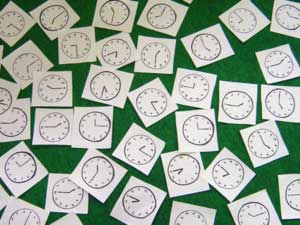
thousands of clocks

I just made a ‘telling the time’ game to play with the elementary school kids, which involved throwing forty-eight paper clocks on the floor and shouting a time which the kids then have to grab. The reason I’m telling you this is just because of the interesting and unanticipated psychological effect I experienced when I spread the cut-out clocks out on the floor. I looked down at all the clocks, all looking almost identical, but telling different times, and it freaked my mind out (to use a technical term). “Ooh, this is a difficult game,” I groaned, involuntarily. “No, no – I think it’ll be ok,” said the teacher. But I didn’t mean ‘this will be too difficult for the kids’. I meant ‘argh, too many clocks, too many clocks! Limitless, incomprehensible space and time stretching away from us in all directions!’

posted in Okinawano comments

creatures of the deep

February 15, 2004

scuba divers

In the middle of last week, the weather turned mild and sunny, so this weekend I did another two scuba dives. This time they were proper dives – down to six metres, which is not very deep, but deep enough that you have to go down slowly and allow your ears to adjust to prevent them from bursting. Due to some sort of blockage inside my head – probably the remnant of a bad cold last weekend – I had big problems adjusting the pressure in my ears, so it took me a long time to get down to the bottom. The problem with my ears made me very aware of the pressure differences (for the scientifically-inclined, at six metres down the pressure is 1.6 atmospheres): when you scuba-dive, you’re breathing compressed air that comes out of the tank at whatever pressure the water, and consequently you, are at, so if you go up too fast, then the air inside you is suddenly at higher pressure than the air or water around you. From six meters, that would make your ears hurt very badly. From deeper, worse things would happen. I was thinking about pressure when N-san, the diving instructor, pointed out a small, delicate, multicoloured creature called a ‘sea cow’ (in Japanese) on a rock. It looks a little like a slug, but a rainbow-coloured one, with lots of feathery little fronds coming off it. I thought to myself how strange it is that this delicate-looking little thing is actually at high pressure, and how if you took it up to the surface it would EXPLODE, and then I remembered that actually we were only six metres down, and not at the bottom of some ridiculous ocean trench, and that actually things at six metres down are not at such high pressure that they would do anything like exploding if you carried them up to the surface*. Still, when I went back up to the surface, I once again had trouble adjusting ear-pressure, and so had to go up slowly (maybe four or five minutes to cover six metres), and this time I realised that when you scuba-dive, you actually do become a creature of the deep: that even though you can see the surface up there – the place you’re from – you can’t just go straight back there, because the conditions there – the conditions that for 99.9% of the time support your life – would hurt you. It seems natural that going to an alien world should take time, that you should need to adjust, but it’s a strange feeling that the return must also take time, not because of the distance you have to cover, but rather because of what you’ve become in the meantime…

* Actually, now I think about it more scientifically, the sea-cow would also be much less affected by changes in depth than a diver, because of the crucial difference that the diver has a lung-and-headful of compressed air, whereas the sea-cow doesn’t. Since water isn’t really compressible, but air is, changes in depth will affect a diver much more than a fish. This doesn’t mean, though, that a fish brought up from enormous depths very fast would not explode. It might do.

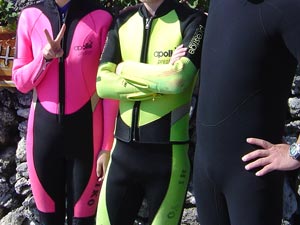
That’s me in the yellow, by the way. I’ve cropped the picture at shoulder-height partly because I have an anonymity policy, but mainly just out of fear that if you saw both my lithe, wetsuit-clad body and my manly face at the same time, it would prove too much for you and you might swoon and smack your forehead on the keyboard in front of you. That’s Emiko in the pink, and N-san is in the black.

posted in Okinawano comments

rabble-rousing and reckless driving

February 10, 2004

A kid just came into the staff-room, came up to me, and said “暴走族”, and nodded at my computer, meaning “look that one up in the dictionary, then”. The definition of this word, quoted word-for-word from my dictionary, is a ‘club of rabble-rousing reckless-driving delinquents‘. The fact that there is a single word for that makes me like Japanese a lot.

Kim tells me that actually 暴走族 just means ‘motorcycle gang’, which is much less interesting, and makes my dictionary seem a bit eccentric.

posted in Okinawano comments

other people’s music

February 7, 2004

May I draw your attention to the fact that Other People’s Music, the debut album from The Unrecorded is now available for listening and purchase at moontune? [these days it’s at seatunes.org – 2006/05/02]

“Other People’s Music” is the fruit of four years’ simmering inside the mind and computer of Mr. Andrew H, and features the unprecedented, searing voice of Jess Bryant sweeping like a helicopter floodlight over the rain-swept streets of Andrew’s music in search of crackly, out-of focus fugitives.

I’m not recommending it just because they happen to be two of my favourite people: even if I found them both extremely objectionable in numerous ways and also, frankly, slightly unpleasant-smelling, I would still have to admit that they had made an album of indisputable, shimmeringly splendid splendidness. As it is, I can assure you that they are also two of the nicest, most fragrant people you could meet.

If you were to want to know what Other People’s Music sounds like, I could say words like “grainy” and “dusty, crackling hammond organs“, and “the whispering voices of the electromagnetic waves“, but you would do better to go to moontune seatunes yourself and have a listen to the extracts there – One Second, for example, or This Is Mine, or Other People’s Music – and then if your heart isn’t immediately seized by the violent urge to purchase and own the album and listen to it over and over, then I’ll eat… let’s see… this pamphlet about dangerous Okinawan marine life. Ok? Good.

The more observant and suspicious-minded of you might see my name mentioned in the credits of this record, and think “hold on just a second here – what are you up to?”. I would like to put you at your ease by saying that my contribution consisted of recording Jess’s vocals and supplying a few samples. I’m not part of ‘The Unrecorded’, and I’m not getting any of the money. So this is a recommendation, not some kind of ‘infomercial’, for goodness’ sakes. Sheesh.

posted in Okinawano comments

in cars

February 3, 2004

a tv in a car

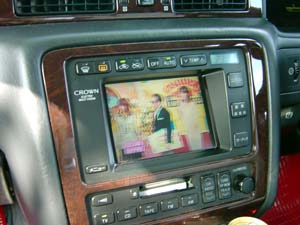
When I got back to Okinawa from Osaka, on arriving in the airport I almost immediately ran into a bloke from my island, and thereby managed to get a lift all the way to the port (saving me nearly three hours of bus and taxi rides). After Osaka’s breath-condensing chilliness, it was strange to see clear blue skies and people walking round in t-shirts. In the car was a gadget that is not only extremely Japanese but also probably one of the worst ideas of all time: a car tv, set into the dashboard, and presumably intended for the driver to watch. I’d heard about these things, but I always assumed that they were behind the driver, for passengers. But no – right there, in the middle of the dashboard, above the car radio. We watched game shows for a fair chunk of the ride home, and somehow managed to avoid causing any major traffic incidents.

Kim tells me that actually the ‘dashboard’ is the bit directly behind the steering wheel, and that the bit to the left, despite being continuous with the dashboard, is not in fact the dashboard proper. I stand corrected, and I would like to apologise for my misleading and confusing use of language in the above entry.

posted in Okinawano comments

two religious experiences

January 31, 2004

God in a can
Jesus theme restaurant

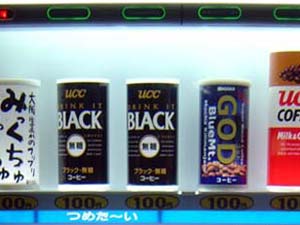
I found God in a coffee can in a vending machine in southern Osaka. So that’s where He’s been all this time.

What a peculiar fellow!

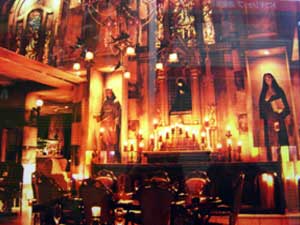
We also walked past a Christ-themed restaurant. Or rather a restaurant whose aesthetic seems to be a Japanese take on Catholicism at its most gothic and florid. A slogan in the window informs passers-by that:

“The shiny golden altar in our shop is real, and it was used at the church in Europe. Please enjoy our perfect situation, service, dishes and music. We are imagining like a church. It is a perfect space for adult. Please enjoy your time.”

After I’d picked my jaw off the ground and put it back in place, I was surprised to realise that I was actually offended. Not that I’m a Christian, and I’m still less of a Catholic, but I think it was the amount of disrespect involved in treating a religion as just another source of inspiration for interior design (although now I think about it, I wonder if that isn’t exactly how a lot of Westerners see, say, Zen Buddhism…) The sheer wrongness of it reminded me of the time a friend (Dave) went to Florida and saw an adventure playground based on the sinking of the Titanic. Although obviously, that’s much, much wronger.

posted in Japanno comments

powers i have recently acquired

January 26, 2004

A few years ago I had a daydream that one day I would be a walking sampler, able to capture anything I saw or any sound I heard and preserve it in some crisp, permanent form forever. I realised the other day that I’m now at least part of the way there. On my arrival in Tokyo I bought a small digital camera which I now carry with me at virtually all times, and whose photos decorate this page. It’s small and silver, and takes very good pictures with a minimum of effort and the bag I always carry with me has a pocket that is just the right size for it. This means that, given enough time to take my camera out of my bag and turn it on, I can catch anything I see and store it in the form of five million lush, crisply-coloured little pixels.

If I don’t have time to take out the camera and turn it on, my japanese mobile phone is always in my pocket and always on, and can also take photos and films. They’re much worse quality than my camera, but they’re ok, and the ability to immediately email them to anyone makes me feel like a time traveller in possession of a technology that there’s no way I could explain to the authorities if they ever caught me.

The third and last device I carry with me I bought in Osaka. It’s a tiny, silent black case, with a glowing blue screen, into which I can place 20 gigabytes of the world for safekeeping. It’s the same sort of thing as one of these ‘iPods’ that seem to be all the rage these days – in that it has a headphone-socket, and the main use thing it’s intended for is to be used as a 21st century walkman. However, it’s better than an iPod, for a number of reasons. Firstly, it has a built-in microphone, which takes me another step towards being a human sampler: I can now, at any time, start recording and – if I feel like it – continue recording until the moon falls out of the sky. Power Extreme! Secondly, it plays music in “Ogg Vorbis” format.

“Ogg” is an alternative to mp3, and it is better for two reasons – firstly, it sounds much better than mp3. I don’t know anything about the technologies involved, but I find that mp3s sound funny, and slightly unpleasant, to me, whereas I am really pressed to hear any difference between an ogg file and the original cd, even though the ogg file is the same size as an mp3. The second reason why Ogg is better than mp3 is political: mp3 is a patented technology, whereas Ogg is developed by the Xiph Foundation, who are a non-profit corporation whose aim is to protect “the foundations of Internet multimedia from control by private interests”, by providing patent-free alternatives to things like mp3. Personally, I think that is a very, very good idea, so I would probably have still gone for an ogg player even if it didn’t also sound better than mp3.

Finally, another thing that counts as a plus for me is that my Pod thing is one of the few of it’s type that isn’t made by an American corporation. It’s made by a Korean company called iRiver. This means that in buying it I didn’t do anything to help the economy of a country that seems to me, under its present government at least, to be a pretty large threat to any kind of positive future for the world…

Apart from wanting to be a human sampler, a big part of why I bought the thing was because I’ve been really missing both my walkman and my dictaphone – before I got the iRiver thing, I could only listen to music in my house (I bought my predecessor’s hi-fi off him), but listening to music while you do the washing-up is not the same as listening to music while walking the mean, rain-drenched streets like some kind of private eye. But now I realise that on my small island I almost never walk further than about one song’s length (I live about five minutes away from school). Piss.

posted in Okinawano comments

osaka sex shop window

January 23, 2004

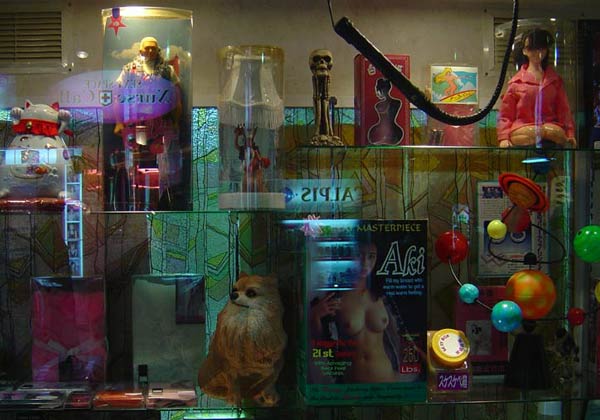
For the last two nights in Osaka, Alex and I stayed in a nice little hotel right in central Osaka, with traditional-style Japanese tatami rooms. When we arrived, it turned out to be right in a red-light district. The street outside had a weird, otherworldly feel to it – bizarre signs everywhere and strange ‘information booths’ that, while it wasn’t exactly clear what they were selling, were clearly not there to help lost tourists… A man stood in the street outside a bar in a long, pristine white jacket with the word “crutch” printed all over it in a bold, black, sans-serif typeface. We passed a car park that contained the largest collection of expensive cars with blacked-out windows that I’ve ever seen – a reminder of the fact that the Yakuza probably have a hand in most of the businesses in this part of town… Just along the road from our hotel, I took a photo of the window of a sex shop, which I have put here, partly so that no-one is shocked or embarrassed at having a picture of a sex shop window suddenly and unexpectedly pop up on their screen, but mainly because it is the details that make it interesting, so for it to be worth seeing, it needs to be bigger than the standard-size photos that I use on this page. Please don’t look at it if you are likely to be offended by the contents of a sex-shop window, which contains, among other things, a small picture of a naked lady, some moons and planets, and a porcelain dog.

posted in Japanno comments