light vessel automatic

skip to navigation

the best saxophonist in kathmandu

December 12, 2004

a view of the sea

Hello. I’ve been neglecting things here recently for various reasons. Partly because I’ve just been generally busy with about fifteen different things. Partly because I’ve been feeling that this site doesn’t really cut the mustard as a way of staying in touch with people: it’s meant to be a less-annoying alternative to mass-mailing, but unless people can leave comments it’s far too one-way for my liking. But I’m too stubborn to admit defeat and just start using WordPress (as I came close to doing a while ago). So lately whenever I have had time to do something LVA-related, I’ve tended to spend it working on making a new version, with comments and that sort of 21st century cleverness. Soon, soon.

Anyway, lately I have quite often been being surprised by enormous birds. Yesterday, some sort of enormous crane, today a big hawk, wheeling in lazy circles over the sugar cane fields. I have also been drinking coffee with a French saxophonist called Tony, who is visiting the island for a couple of months from Nepal, where he lives for most of the year. He says he is the best sax player in Kathmandu, by virtue of being just about the only sax player in Kathmandu. He came here in October with his girlfriend Yuko, to visit her friend Kaori, who I play in a band with. Since he doesn’t speak Japanese, and since I’m the main source of non-Japanese conversation on the island, we’ve been meeting up quite often lately. We sit outside my house and drink coffee and he tells me stories about shaking Sonny Rollins’ hand, and telling Jerry Hall and Mick Jagger to fuck off. Exactly the sort of story you would hope and expect the best saxophonist in Kathmandu to tell.

Typhoons have also continued to be an annoyance. Most years the typhoons stop at the end of October, but this year they’ve persisted. Their timing has been uncannily bad all year – keeping me off the mainland for almost the whole summer, and almost always falling on weekends. A couple of weeks ago, K visited from Osaka, and the perfect warm weather was replaced with grey skies and howling winds for the week she was here. The day she returned, the cloudless blue skies came back. Somewhere in between, the typhoon also prevented me from going to both a wedding on the mainland (which would have been my first Japanese wedding) and a taiko performance.

Right, so. I’m off back to the UK again on Thursday – for my cousin’s wedding, this time. Christmas over there, then back here for New Year, which sounds like it might be quite exciting. Last week I started going to twice weekly sanshin lessons – of real old traditional Okinawan music, more classical than the folk songs I’ve been learning so far. The old men who teach me will be playing at the New Year concert. My predecessor is coming too, and since he plays piano, Y’s idea is that we should give a performance of some Okinawan music together.

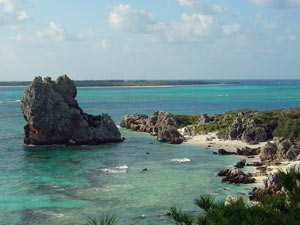
Yesterday was a holiday, so I went for a cycle round the island. I took this photo from one of my favourite places.

posted in Okinawano comments

osaka with k

November 29, 2004

On the way back from the UK, I visited k (who a while ago I was worried I might never see again), in Osaka. Although it has a reputation as an exciting city, the first time I went there, to meet Alex at New Year, we had trouble finding exactly what it was that’s so great about it. Compared to Tokyo, it just seemed like just another ugly, nondescript metropolis, and although we did some interesting things there, I was left a bit disappointed.

I now suspect that it’s Osakan culture, rather than any particular place, that is what Osaka has going for it, and that the way to see it is with a native of Osaka. There’s a sort of rude, loud, bustling friendliness to Osaka that’s quite different from anywhere else I’ve been in Japan (interestingly, it maybe has some things in common with Okinawa, where they don’t go in for the whole formality thing to the same extent, either).

So I stayed with the very Osakan k, and her mum and brother, both of whom would individually have qualified as two of the nicest, most interesting people I’ve met in Japan (her little brother has uncannily similar taste in music to me: from the obvious to more unusual things like Sparklehorse, Mogwai, and Boards of Canada, none of which are particularly big in Japan, I don’t think. He’s even into Múm, and the Olivia Tremor Control – an obscure band I saw more-or-less by accident in the ICA in London about seven years ago. He’s also an absolute wizard at pool, having spent the last few months working the night shift at an all-night pool hall).

Like Okinawa, Osaka also has a rich and strange dialect, but because lots of TV comedians come from Osaka the dialect has the advantage of being understandable (and amusing) to people all over Japan. Okinawan dialect, on the other hand, is incomprehensible outside Okinawa. Which is also fun, in a different way. So as I wandered round Osaka, k taught me quite a lot of Osakan dialect, and since I got back I’ve been enjoying suddenly dropping loud Osakan interjections (“Really? No way!” sort of thing) into my conversation and watching people’s reactions…

I also, in a public bath around the corner from k’s house, had my first (accidental) experience of the infamous denki furo or electric bath. It took me by surprise: I’d gone into the bath-house, showered as you’re meant to before getting in the baths, dipped a toe into the nearest bath to check the temperature, and —without reading the sign—climbed into it. Just as I was sitting down, all the muscles in my body suddenly violently contracted and the shock made me jump out again. I then experimented, lowering my hand towards the electrode, and watching the fingers involuntarily curl up. It’s an experience that feels so strange that while it’s definitely not pleasant, it’s hard to say for sure that it’s definitely unpleasant, either… (by the way, here is a great article about the denki furo…)

Kim has been conducting an informal poll among people she meets in Japan: “Do you like the denki furo?” No matter who she asks, she always seems to get the same answer: “No, but I think maybe old people do.” Which is exactly the answer k gave me, too. From which I suppose I can only conclude that old people (old Japanese people, anyway) enjoy being mildly electrocuted.

Hmm… a strange indication of the paths of least resistance through my brain: when I read the headline “Prince backs healthy school meals”, my first reaction is surprise that a funk grandmaster – even a notoriously eccentric one – would feel strongly enough about this topic to make his views public.

More importantly, look at this: like those ‘Parental Guidance – Explicit Lyrics‘ stickers—only for biology textbooks!

posted in Okinawa1 comment

sanshin

November 24, 2004

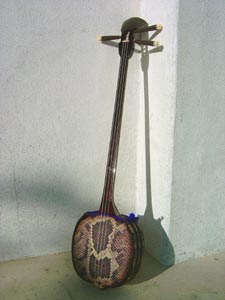
my new sanshin

I’ve been away for a week in Naha city, and while there I finally managed to pick up the sanshin (三線) I ordered in July. (I was kept away from the city for most of the summer by typhoons). It’s beautiful, and hand-made by Mr. Matayoshi of Matayoshi Ryūkyū Instruments (又吉琉球楽器) in Naha. I found his shop by asking the person whose sanshin I like most where they got theirs.

Sanshins are traditionally bound with snakeskin, but since that’s neither vegetarian nor (perhaps more importantly) legal in the UK (and a lot of other countries), if you are intending to take your sanshin out of Japan you need to buy a fakeskin one instead.

The first time I went to Mr. Matayoshi’s shop, all his good sanshins were snakeskin ones, so he told me to call him a week or so before I next came to Naha, and he would make me two non-snakeskin sanshins to try, and that if I didn’t want either of them, that would also be ok. I took him up on his offer, and when I finally made it back to his shop, he had two waiting for me to try. Usually it takes me ages to make this sort of decision, but this sanshin was just exactly right, and I decided to buy it within minutes of picking it up.

My precious

There’s a picture of my old, borrowed, sanshin here, if you would like to compare and contrast

posted in Okinawa5 comments

samhuinn

November 15, 2004

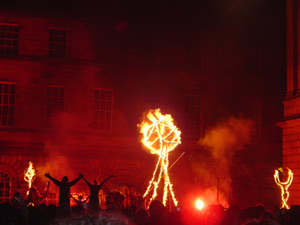
Samhuinn in Edinburgh

On my last evening in Edinburgh, I met Jess in the new Forest Café, which is excitingly enormous compared to the old one (and is, incidentally, one of the best places I know of). After saying goodbye to Jess, I turned onto the Royal Mile to hear drumming and see huge burning Wicker-Man-esque sculptures, and then I realised that it was Halloween—or rather, Samhuinn (or Samhain). It was an especially impressive one this year, and the drumming rocked.

I realised when I heard the drumming that George the drummer (and other familiar faces) would likely be around, so after I’d taken some photos I had fun wandering through the crowd finding people I hadn’t seen for a long time to say hello to…

posted in Okinawano comments

what i did in the uk

November 8, 2004

Hello. I’m back now. And I’m sorely tempted to launch straight into some sort of tirade about the state of the world, but before I do anything like that, let me tell you what I did in my holidays.

I went back to the UK for my friend and former bandmate Liz’s wedding. The wedding was in Scotland (Liz is from Glasgow), which meant that I got to walk the mean and windswept streets of Edinburgh once more, if only for four days, and I got to see lots of people I haven’t seen for more than a year, and some people I haven’t seen for three or four. The strangest thing about being back was that it didn’t feel strange to be back. No reverse culture shock. Everything unnervingly familiar. The eeriest thing was going back to my old flat—as I went through the front door, it felt like literally only two or three days had passed since I left for Japan… as if the last year took place in some fold in the space-time continuum, or like I’d been to Where The Wild Things Are

So, apart from the obvious meeting of relatives, I drank my first (proper-tasting) Guinness in over a year with Andrew and Kirsty, went to see the play that is my sister’s first proper acting job (Midsummer Night’s Dream at the Greenwich Playhouse), and then went up to Edinburgh, where I went to a restaurant with Stuart, met Dave in a pub, cooked an unfortunately rather minimalist (there was nothing in my cupboards, ok?) meal for Jess, and was cooked a much more delicious and spicy meal by May. Then went up to the wedding with Liz’s old flatmates Mabel & Vivienne, and V’s boyfriend. After the wedding, stayed the night with two friends of Liz, got fed a fantastic Indian ommelette breakfast, and departed carrying a big jar of delicious home-made pineapple chutney to see Sheila the drummer, in Stirling. Finally, back in London, I managed to meet up with old, old friend Simon for the first time in a stupidly long time.

I’ve got used to the idea that Okinawa is a small place, and that wherever I go – even in the big city – I run into people I know, but weirdly that that now seems to be happening in the UK too (at least in Edinburgh)… As well as all the intentional meetings, I met almost the same number of people again just walking around in the street. Particularly well met were George the drummer, former flatmate Gary (for whom I had no contact details and so no way to get in touch with other than the crafty strategy of coming out of May’s flat at exactly the right moment to see him crossing the road ten metres away), and Rich from (Edinburgh band) the Peggy Vestas, who I saw jump onto a carriage further down the platform at Waverley, and who I located a little while later by text messaging, apparently at the exact moment that his iPod played a song that I gave him a copy of, and which had caused him to think “I wonder where Nick has got to these days…” (This was nicely symmetrical with a thing that had happened to me a couple of days before, where I said to myself “I’ll call Jess as soon as this song finishes”, and then, just as the song finished—right on cue—Jess called me…)

posted in Okinawano comments

dog

October 21, 2004

A: Why did the dog cross the road?

B: I don’t know. Why did the dog cross the road?

A: It was chasing a moped.

B: Why was it chasing a moped?

A: For the purpose of exercise.

B: And was the moped’s rider complicit in this?

A: He appeared to be, yes.

B: In what way?

A: He was driving quite slowly.

B: …this isn’t actually a joke, is it?

A: No, just a thing I saw. A minute ago.

B: Why are you wasting my time with this rubbish?

A: I don’t know. I’m sorry.

posted in Okinawano comments

the halls of valhalla

October 7, 2004

I am sitting in the staffroom of the elementary school. All the windows are open. Just outside, the school orchestra are practising. They all play brass instruments. They are playing one of Smap’s greatest hits. Their version sounds exactly like the music that I imagine greets the souls of dead warriors on their arrival at the halls of Vallhalla.

They have been practising every morning from about 8:30 in preparation for the school Sports Day on Sunday. The weird thing is, they play over the top of whatever jolly morning music is blasting out of the school’s PA system (which has speakers outside, so I can clearly hear it from my house, a hundred yards or so away. The sound of the band playing, apparently unconcerned, against entirely unrelated background music makes me feel a very strange sort of discomfort.

In fact, Japan relationship with background noise generally seems quite different from the UK… (Never one to miss a chance to jump from talking about a single incident to making sweeping generalisations, me). Public announcement systems are a case in point – I remember one morning last year, maybe three months after I arrived, when I woke up one morning to the mobile-phone–ringtone synthesiser version of Fur Elise that blares out of speakers all round my house at 6:30 every weekday morning, and I thought how stupid it would be – how completely gutting – if the reason I end up having to pack this otherwise excellent situation in after a year is just that I can’t handle hearing this horrible fucking music every morning any more. (Fortunately nowadays I’ve got used enough to it that I sleep through it most mornings… it seems quieter, too. Maybe someone did complain…)

I’ve lost count of the number of times Y has come round to my house, put on a cd out of habit, and then, a few minutes later, picked up my guitar or sanshin and started picking out a tune that has nothing to do with what’s playing on the hi-fi.

Another thing that has struck me in Japanese department stores is the background sound of several competing jingles all playing over the top of each other. The result often makes me feel quite uneasy, and I wonder how it affects people who have to work there all day. I’m sure it can’t be any good for their mental health. Mind you, I doubt it could be worse than having to listen to Paul McCartney’s horrible “Simply Having A Wonderful Christmas Time” all day on repeat play, which is what British shop-workers have to put up with for about three months of the year.

posted in Okinawano comments

kanji

October 6, 2004


I’ve been meaning since at least the time I got back from China to write a little bit about the Japanese language‘s peculiar writing system. So…

Japanese has three different alphabets. Actually, if you’re being really strict about the definition of the word ‘alphabet’, it doesn’t have any: it has two syllabaries and a set of ideographs. But never mind that. I’m only really making it explicit here because my ex-girlfriend has a degree in linguistics and Japanese and takes great delight in pointing out even the smallest factual inaccuracies in what I write.

The reason that the Japanese language’s writing system is an eccentric mixture of phonetic and ideographic scripts is largely because it was initially (well over a thousand years ago) lifted pretty much wholesale from Chinese and dropped onto a completely different language for which it wasn’t designed or particularly well-suited. The two Japanese syllabaries were later created (from simplified Chinese characters) in order to remedy this oversight.

So, the two syllabaries, Hiragana (the squiggly script that looks like this: あいうえお) and Katakana (the more modern, angular script that looks like this: アイウエオ) are native to Japan, and they are phonetic, in that one character corresponds to a syllable (both the above examples read ‘a i u e o’). The third set of characters, though Kanji () — Chinese characters — are not phonetic. Instead of representing a sound, they represent a concept or idea. So, for any given sound, there are dozens of characters that could be read that way (shō, say, or ken) but they all represent different ideas. So, for example, 選択 and 洗濯 are both read ‘sentaku’, but the former means ‘choice’, and the latter means ‘laundry’.

Incidentally, a horizontal bar over a vowel – eg. ū, ō – just means that it’s a long vowel (“oooh” as opposed to “ooh”, say). If this is all seeming a bit dry and academic, please be aware that in a few paragraphs time I will get around to showing how to write something rude and amusing in kanji…

Incidentally, this set of (several thousand) ideographs that is used by Chinese and Japanese (although over the centuries, Japanese and Chinese Kanji have experienced a little evolutionary divergence…) and to a lesser extent, Korean, is (I believe) the last surviving hieroglyphic script in use in the world. All similar writing systems (like the hieroglyphs used by the ancient Egyptians) belong to languages that are now dead. Which makes kanji one of the world’s greatest cultural treasures, up there with the music of JS Bach, and the writings of Roald Dahl. Learning this amazing set of characters has also now become one of my main reasons for wanting to learn Japanese.

Writing in meanings rather than in sounds has the strange consequence that there is more information in written Japanese than in spoken Japanese. For example, if you were learning English, and you heard a word you couldn’t remember the meaning of, you wouldn’t necessarily be much better off if you saw it written down. In Japanese, though, once you see it written down, you’ve got a huge clue to the meaning. So, supposing you heard the word ‘sentaku’ — you would have to figure out from the context whether the person meant ‘choice’ or ‘laundry’, but if you saw it written down it would be clear from the characters what the meaning is.

This, in turn, has some strange and interesting consequences. Firstly, it means that written Japanese and written Chinese are (though to a very limited extent) mutually intelligible, despite the fact that the languages are not closely related at all. One of the most exciting things when I first arrived in China was that although I couldn’t understand a word anyone was saying, I could get the gist of a lot of signs. 入口, for example, means ‘entrance’ in both Chinese and Japanese: the first character means ‘enter’ and the second means ‘mouth’. But the way you actually pronounce the word is completely different in Chinese and Japanese. Because of this shared writing system, though, I’ve heard that ancient Chinese and Japanese scholars were able to communicate by writing letters, despite the fact that they couldn’t speak each others’ languages.

Another consequence of the written language being more information-rich than the spoken language is that, as a learner of Japanese, when I hear a word that I don’t know, my first instinct is to try and think of a meaningful pair of characters that could be read that way: often if you can guess the characters, then you can guess the meaning too. So, the first thing I want to know when I hear a new word is “How do you write it?”

Here’s an example of how that works in practice:

Yesterday I was sitting in the elective English class that is my favourite lesson of the week, and I was helping a group of girls make posters in English about different countries of the world. At one point one of them uses the word ‘kyonyū’, and I ask what it means. This triggers a lot of giggling. I assume it’s my accent. “Don’t you know?”, they ask. In my head, I’m trying to fit Chinese characters to the two syllables. I’m thinking “Which kyo? Which nyū?” The only plausible pair I can think of are kyō, 競 (race) and nyū, 入 (enter)… but somehow that doesn’t sound quite right… Usually the verb bit goes first, like in nyūgaku 入学 (entering university), nyūkoku 入国 (entering a country), or nyūin 入院 (going into hospital). Or for that matter iriguchi 入口 (entrance). (I didn’t mention: in Japanese, there are usually at least two different ways of reading each character… the Chinese reading and the Japanese reading…)

“Is it something to do with running in a race?” I ask.

“NONONONO Noooo!”

While I’m racking my brains the girls are reeling off alternative words, none of which I understand any better than kyonyū. I’m scratching my head, and Chinese characters are flashing past my eyes. As they go through all the alternative ways of explaining this word, the giggling progresses to screaming, side-clutching, desk-slapping hilarity. One girl, Mina, is crying with laughter. She can’t speak. There are tears streaming down her face. They’re trying to get a boy at the back of the class to mime the word when Mina, wiping away the tears but still unable to speak, writes the word on her hand and then holds it up for me to see. The moment I see it written down, I understand the source of the hilarity: kyo is 巨 (meaning huge) and nyū is 乳 (meaning breasts).

Oh ho ho!

Breaking News:
Cheney Vows To Attack U.S. If Kerry Elected
posted in Okinawano comments

kumi-odori

September 28, 2004

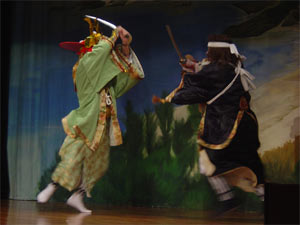
leaping swordsmen
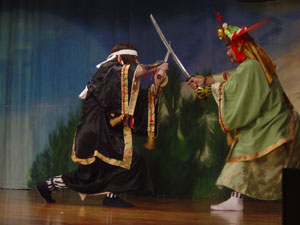
more swordfighting
a wicked king
Eisa dancing

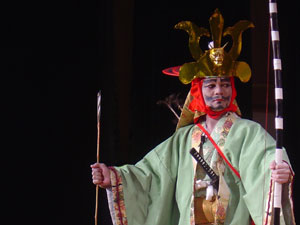
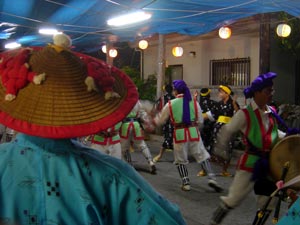
On Friday and Saturday of last week the island’s villages once again had festivals. This time it was the Hōnensai (豊年祭), which translates as ‘Fruitful Year Festival’. I’m not sure quite what that corresponds to in English—I would translate it as ‘harvest festival’, if it wasn’t for the fact that the harvest festivals were in August. Anyway, the Hōnensai is considerably calmer than the Unna (harvest festivals) of August. Instead of fire, copious booze, tugs-of-war and wrestling, this time round consisted mostly of music and dance performances. In particular, the village where I live put on an Okinawan Kumi-Odori (組踊) play. Like a lot of Okinawan culture, Kumi-Odori seems to be a mixture of both Japanese and Chinese influences. The closest thing to Kumi-Odori that I know of is Japanese Kabuki, but there’s a definite Chinese flavour to the brightly-coloured costumes as well.

As well as the Kumi-Odori, there was a performance of traditional Okinawan Eisa – a sort of drumming dance. It actually reminds me strangely of Morris Dancing (although it’s slower), particularly because the men’s costumes even look quite Morrissey (and I use the word ‘Morrissey’ here mainly because I get a perverse and inexplicable sort of pleasure from the idea that we might, at this point, be joined, via Google, by a small number of puzzled Smiths fans. So: Morrissey, Morrissey, Morrissey, Morrissey Morrissey, Morrissey).

One of the things I really like about Okinawa is the fact that virtually everyone seems to learn at least one traditional Okinawan art to at least a basic level — be it eisa, sanshin (banjo), folk song or karate (Okinawa’s most famous cultural export). I’m sure this dedication to preserving folk culture is at least partly because of Okinawa’s rather sad history, which has led—as a consequence firstly of being conquered by Japan and then (a couple of hundred years later) of being the scene of some of the fiercest fighting of WWII—to there being almost no surviving writings or art from the Ryūkyū (pre-Japanese) period.

Whatever the reason, the contrast with the UK is pretty stark. Since the last time I saw Morris Dancing, when I was a little kid, I don’t think I’ve heard it mentioned other than as an object of ridicule. Folk music doesn’t have it quite as bad as Morris Dancing, but it’s still definitely uncool. The sad thing is that, hip or not, there’s a rich history there that we seem to be pissing on even as we embrace the Great Monoculture of brand name t-shirts and coffee that, though mediocre, tastes reassuringly the same here as it does at home.

As well as all that high culture, I performed in a dance to a silly children’s song that seemed to be called ‘Fish Fish Fish’. With me on stage were the (very smiley) deputy head of the elementary school, my next-door neighbour Mrs. K, and a couple of dozen elementary school kids. We had cut-out paper fish stuck all over us, and the dance involved pom-poms and mime. I danced, I think, with all the requisite poise and grace.

posted in Okinawano comments

a strange performance

September 24, 2004

super heroes

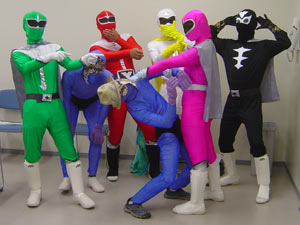
Last Friday, I took part in an extremely strange performance. Y’s band was playing at a party to celebrate the aged, and Y decided, three days before this, that I would play drums with them, while he played bass. Strangely enough, he decided this in spite of the fact that he is a very good drummer and I have never played drums with a band at all, whereas I’ve been playing guitar for a long time. I wasn’t playing a full kit, but rather a set-up of Y’s invention: two small taiko drums, and a larger, upright, very boomy Okinawan drum, placed on a stand at waist height, and played with light taiko sticks (which are still a lot thicker than conventional drumsticks). Despite the fact that we only had two rehearsals, I think I actually managed to play reasonably competently – since I was only playing with sticks, I didn’t have to worry about the hand-foot co-ordination that always throws me when I play on a kit, and the similarity with taiko-drumming was close enough that I wasn’t completely in the dark.

Anyway, the day before the concert, Y decided that it would be good to have some super-heroes fighting on stage while we played.

K, another island friend, for several years performed in (ultra-Japanese!) Saturday morning live-action super-hero shows for kids at department stores. So, knowing the moves and having a pretty good feel for the storylines, this summer he created the “Sea Rangers”—this island’s own super-hero show—for the biggest festival of the summer. It went down very well with all the local kids (there’s a video of the festival, and when the Rangers take their final bow and go off stage, that triggers a stream of kids rushing past the camera towards the backstage exit to meet them that goes on for several minutes), and so since then there’s been a general feeling that the Sea Rangers will return at future events on the island. Y decided that this concert for the elderly would be an excellent time for them to come back and show off their ninja skills. Strangely enough, I think he was right.

After we finish playing the first song (an Okinawan ballad), two superheroes rush on stage and start fighting viciously with staffs. At one point they get so carried away that they nearly fall into the crowd of delighted elderly ladies clapping at the front of the audience. Me and Y give the fight a rattling, clanging percussion soundtrack – this time with Y on drums and me banging a gong. Then they bow, and walk out of the theatre. We play a more up-tempo number. Then K and one of the elementary-school teachers, chosen because she’s a karate black-belt, come on and do a karate demonstration. It’s particularly interesting to watch if you know that she’s a genuine karate expert, whereas he is actually just a very talented mimic, copying her from the corner of his eye. Before the show, backstage, he was practicing along with a video he’d taken of her on his mobile phone, which was one of the most interesting uses of mobile technology that I’ve ever seen.

The whole thing was completely nuts. I want to do it again!

posted in Okinawano comments